

News
The Closing Festival Days - A Change of Perspective
Back to...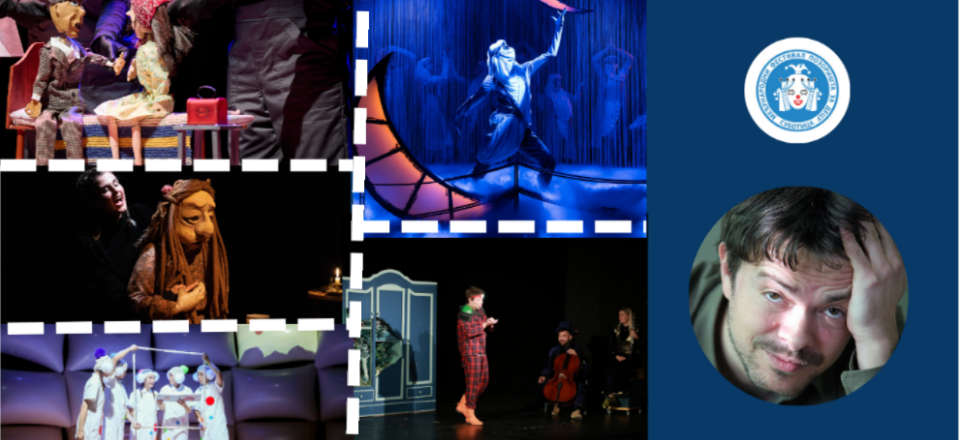
Felicia is not exactly happy. She lives in the forest, but the animals do not like her. They believe she is taking away their property and disturbing their peace. In other words, they think she is a bad neighbour who does not do what is best for everyone - who does not participate in forest life in a way that meets their expectations.
She seems lonely and strange, collecting objects she finds. She is also suspected of plotting various conspiracies and brewing all kinds of poisons. A witch!?
Felicia is the title of a production that came to the festival in Subotica from Italy, presented by the Quintoequilibrio Theatre. Its creators are Stefania Ventura and Quinzio Quiescenti, who is also the director and set designer. The puppets were created by Giorgia Goldoni, the music features works by several artists, and the performance is presented by Stefania Ventura.
The forest setting is convincingly brought to life through lighting design, creating a dark space that becomes visible only where the audience needs to follow the action. We first see a little house, then the leaves, and gradually meet Felicia, her tea-party table, and the cabinets where she keeps her decorations and trophies. Everything is made of natural or distinctly old-fashioned materials, evoking the spirit and atmosphere of nature.
A mysterious atmosphere is established from the very beginning of the show, with hints that the story will be frightening. The stage is dark, and the only figure dancing, singing, and addressing the creatures of the forest is, in fact, an actress who, through her inspired performance, gradually takes on the contours of a forest creature herself. Soon, she enters Felicia's world, or rather, Felicia takes her in and leads her through the house, which embodies her life and daily routine.
Interestingly, the merging of the actress's character with the character of Felicia is presented through a wrestling scene. Not only does it feel realistic and frightening, but it also recalls the biblical story of Jacob wrestling with the angel. For those who don't know and don't wish to Google it (spoiler alert!), through that struggle Jacob undergoes a transformation and receives a blessing.
The next scene shows a tea party and the preparation of a "potion". Old Felicia goes about it with remarkable patience and takes her time. After the dynamic opening, time begins to slow down, and I personally find myself reflecting on how much time we have for our own rituals, and how much time we allow for them in the theatre, when seemingly nothing important is happening. Much of the audience - after all the shrieking and screaming - watches this quiet section of the play as if hypnotised. I realise that the scene serves to reveal the character. The older woman is enjoying herself. And I begin to enjoy it, too.
Throughout the performance, our investigator of Felicia's life - the actress embodying the forest creatures - asks her questions and remains suspicious of the old woman's actions. The actress does an extraordinary job of differentiating her own voice from Felicia's, with such mastery of ventriloquism that, at times, I find myself looking directly at the oversized puppet's mouth, convinced that it is speaking, even though their heads are very close together. I interpret the larger size of Felicia puppet as a way of making the actress - in her role as a forest creature - appear smaller and distinct from this imposing human figure. It also seems intended to heighten Felicia's potentially frightening effect.
Scene by scene, Felicia leads her uninvited but welcome guest around her home, answering her questions with naïve honesty and even a sense of playfulness. When they reach the cabinet containing the animals, Felicia explains that they are dead, but does not say that she killed them, as she is suspected of doing. She tilts her head as though hanging from a rope, changes her voice, and says, "Dead" (the performance was in English).
The question of death and how it is addressed, alongside the questions of ownership and community - which can be interpreted as a herd mentality - are crucial political dimensions of the production. For me, this is the most valuable work in Marijana Prpa Fink's festival selection, aesthetically, ethically, and politically.
Which is to say: Felicia is pure happiness!
***
The Star and the Darkness by Matej Milošev and Buga Marija Šimić Milošev, who also directed the production for Mala Scena Theatre from Zagreb, explores the subject of fear. In the case of a boy called One Me, that fear is the fear of the dark.
Filip Sever, playing the boy, is exceptionally lively and captures the character of a preschool or early- school-age child. One Me is equipped with a lamp, candles, protective gear, and everything else that might help him fight the terrifying force of darkness, whether it is hiding something or simply lurking, empty, beneath his bed. Sever's acting may be just a shade too exuberant in its psychological nuances for us to genuinely feel frightened or believe that he is afraid. But that's all right - the fear is universal. The dark really is frightening.
Two musicians are the production's constant companions. At times, they represent the darkness surrounding the boy's bed, while also accompanying the action. As a result, the acting - and later the puppet sequences - are infused with a strong and vivid musical presence. The music was composed by cellist Matej Milošev, who is joined on stage by clarinet player Ema Štern.
The plot develops through the boy's fascination with a star he sees in the night sky through his bedroom window. Because it shines, he wonders how it manages to cope with all that darkness in which it appears every night. At that very moment, the charming star falls down, and the boy decides - naturally in a dream - to go search for it and save it - just as the star saves him from the waking state in which he is afraid of the dark.
This is where the adventure begins. Within the boy's bedroom, the creators develop a world of puppetry and nocturnal creatures - a firefly, a jellyfish, a coral reef - in which each creature's light offers One Me a new experience. His journey continues until he reaches the wisdom of a star and discovers that, by searching for it, he has confronted his fear for the first time and found peace after realising that he is brave enough.
The choice of marine creatures is somewhat unusual, since, without assuming that the boy is dreaming - and even with that assumption - we are not entirely sure how he would establish contact with them. Yet the underlying truth remains the same: the sea glimmers at night, just like a firefly, and without darkness, there would be no light.
Still, the fact remains that the boy's mother has tucked him into bed, and that a sense of security comes from within. This is the driving idea behind the production, and it gives the audience the pleasant feeling of having watched something meaningful.
***
I was surprised by The Immigrant, a production by Teatre Firulete from Spain. One of the most pressing political issues of our time is told through the language of puppetry and theatre for children and young audiences in a way that can undoubtedly spark numerous discussions.
Menge is a character who, suitcase in hand, meets a woman with a suitcase at a port. While they wait for a ship, scenes of the two sitting on a bench alternate with scenes in which Menge sits opposite a uniformed official who confiscates his passport and throws it into a bin. Menge then works in a factory, hammering away, where another character harasses and mocks him while eating and drinking. As the action progresses, the uniformed official and the factory owner, let us say, subject him to further abuse, until Menge ends up dejected on the street. The only ship he will ever get to meet is the one that comes from the sky.
Pretty brutal, isn't it? Since this is one of my favourite subjects in theatre for children, I believe that preschool teachers and schoolteachers will have plenty to discuss with the children. But how should we approach this subject?
The first thing that comes to mind is that it invites two possible responses. One would be to dismiss it as cruel, unnecessary, one-dimensional… The other would be to defend it as necessary, truthful, and profoundly important. As we can see, these responses are polar opposites, while meaningful discussion usually takes place somewhere in between.
So let us try that approach. My view would be that it is essential for art to engage with subjects such as immigration, exploitation, and abuse. Art for children does this, too. Take Cinderella, for example, or Othello. I notice that each of these stories offers several layers of meaning that move beyond a simple black-and-white division, thereby making the story more credible.
A uniform cannot serve as an excuse for evil, just as an eternal voyage cannot compensate for a peaceful life. Portraying injustice is an exceptionally complex task, and the artists from Spain had a very good and noble idea. However, they achieved little beyond eliciting astonishment and compassion, while also struggling with dramaturgical ambiguities and weaknesses in the puppetry itself.
***
If productions were judged on professional craftsmanship - the handling of the material, puppet manipulation, technical equipment, production values, and ambition - then works such as Aladdin and the Magic Lamp would always come out on top. And while the jury is deliberating its decisions, I can tell you right away that this production, based on the famous tale from One Thousand and One Nights and directed by Todor Valov - the deserving recipient of this year's Little Prince Award at the Subotica Festival - is not the best one.
For those unfamiliar with the story, Aladdin is a poor boy who grows up surviving on the streets. Falling from one misfortune into another, he is eventually entrusted to a relative whom Aladdin's single mother has placed her trust in. It turns out that the relative is motivated solely by what he can gain from Aladdin's skills, as he needs an old oil lamp with magical powers: a genie emerges from it and can grant every wish in the world. Nevertheless, Aladdin initially retains possession of the lamp and, through it, wins the favour of a princess. After another one or two twists and turns, everything eventually ends happily.
The production Aladdin and the Magic Lamp by the Ruse State Puppet Theatre from Bulgaria, tells this story in considerable detail, retaining almost all of its characters, relationships, and situations (adapted by Dimitar Pishev and Todor Valov).
It adopts the original time and customary setting of the story: the Middle East, long ago. What the creators add are musical numbers that accompany the production from the very first scene to the very last, almost without interruption, filling the gaps between every situation and dialogue. Some musical scenes consist solely of choreography, without singing, while others serve as transitions between sets. The actors hold the puppets in front of their chests, lending them their own limbs, while the puppets' heads effectively create a double-headed appearance. The actors themselves wear Oriental robes, and the entire set design is built around materials such as silk and velvet. Although I doubt that the materials used in the production are actually so luxurious, the show feels expensive in terms of the number of performers involved, the sound and technical resources, and the execution of its musical-theatre format - in other words, its musical numbers and staging.
Now, all of this is certainly beautiful and lively, but it raises several fundamental questions: what, exactly, does this ancient story communicate to audiences today? The desire for material possessions, greed, love, naïveté, innocence, fickleness, lust… Which of these themes has not simply been taken wholesale from the fairy tale, without being sharpened or re-examined in the context of the present day?
To what extent can - and perhaps must - theatre move closer to film, particularly animated film? The production feels monumental. On a couple of occasions, as an experiment, I closed my eyes, and the sound seemed to be coming straight from a film. In other words, the vocal performances are excellent, as are the music and singing. However, theatre operates according to different rules, and I did not feel directly involved or engaged, almost at any point, except when I found myself gasping at the near- magical tricks: the appearances of the Magic Carpet, the disappearances and reappearances of characters, all achieved through highly effective changes to the scenic screens.
Even if we accept the conventions of commercial theatre and the musical, the similarity between the costumes worn by the actors and those of the puppets often made me see two-headed creatures instead of a single character.
Moreover, amid the abundance of musical numbers, despite some very good ones, there was not enough musical progression to establish something like a recurring theme over the course of the performance, which would have strengthened the overall experience.
***
Liu Xiaoyi from China is the creator of Everything Changes, a production by the China Welfare Institute Children’s Art Theatre from Shanghai.
The production is intended for the very youngest audiences, from the age of one upwards, which means that its theatrical language is exceptionally gentle, full of softness and warmth. The set, for example, resembles cushions, while the performers' costumes look like plush toys. Their movements are equally gentle, and at several points they involve children from the audience who are invited to try out what the performers are doing.
And what is it that they were doing?
How did they decide to portray impermanence – an almost philosophical concept which occupies such an important place in Chinese culture, thanks to a spiritual and cultural context significantly different from that of the West? How can we accept that - although we grow and breathe - we are here today and gone tomorrow?
Well, they did not go quite that far, but they found a lovely way of conveying what they meant to the audience, without forgetting that we, too, can take part in the process through our own inner contemplation of the subject.
They portrayed impermanence through the idea of growth: a little giraffe meets a big giraffe, presumably its parent. Then, a little fish follows a large fish.
For me, the most beautiful moment came when impermanence was represented through a game of crawling under a bar and then jumping over it when it was lowered slightly. The scene was presented with a touch of humour: we expected the performers to crawl under the lowered bar as well. It could be interpreted as suggesting that changes in perspective also bring about change.
Igor Burić
Back to...-
 25 september 2026
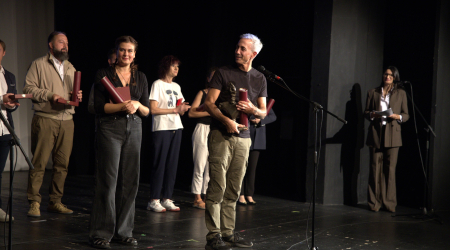
Felicia Wins the Best Play Award at the 33rd International Festival of Children's Theatres – Subotica
-
 25 september 2026
The Closing Festival Days - A Change of Perspective
-
 25 september 2026
17th Research Forum on Children and Youth Theatre Concludes in Subotica
-
 23 september 2026
Matej Milošev: Everyone Carries Both Darkness and Light Within


Patrons


Organiser and executive producer

CO – organiser

Media sponsors