

News
The Third and Fourth Festival Days - What Do Children Know About Theatre?
Back to...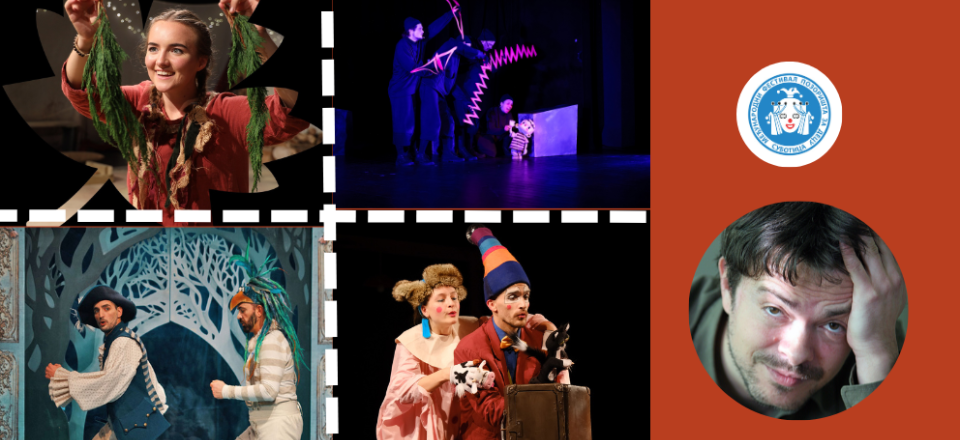
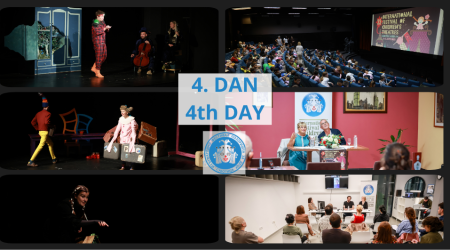
The actors from Wales put a great deal of effort into mastering the Serbian language. They also gathered some autumn branches and leaves, and invited the children to join them on stage. The performance Where the Leaves Blow, by the theatre company Arad Goc, thus became the most open and inclusive of all the productions seen at the festival so far. Beginning their communication with the children even before entering the theatre auditorium, the actor invited them into his home, which he began constructing, like a hedgehog, out of branches and forest leaves. There was a certain warmth and softness to it, too, while for the spikes we might look to the little trees with which the stage was covered.
To be fair, the children were not exactly all that willing to cooperate, but they were visibly interested in the foreigner’s pronunciation of certain Serbian words, as well as in the fact that they were allowed to contribute to the performance, counting and calling out almost throughout the entire show - even in English.
If Duško Radović once said that children complete a performance in their imagination, I would add that educators and teachers should contribute to this process as well, because there was a rather striking difference between gentleness and unruliness when it came to reception, mutual connection, and even intolerance among members of the audience. There used to be a television programme called What Do Children Know About Their Homeland, and I would very much like to watch one called What Do Children Know About Theatre - perhaps even turned into a performance itself.
The actor did not really need the children as his opponents. He had his colleague, who, as he wittily put it, represented the “other dragon.” While he was building and arranging, she was destroying and playing. Which leads us to another question: can destructive energy be transformed into creativity and play?
***
I find myself thinking more and more about the power of theatre for children in terms of education and upbringing. I’m definitely getting old!
When yesterday’s performance opened with the information that the main character was called Ojoj, a mocking ripple of laughter came from the boys and girls. Later, during the next performance, a little boy kept poking me from behind, in the seat and in the back, sometimes with his feet, sometimes with his hands… How threatened must you feel for something like that to give you such pleasure?
Today I tried to find the little child inside myself as well. It is extremely exciting to search for answers to some of the questions that arise in the theatre auditorium at the Festival in Subotica. Ojoj!
The Polish performers from the Pinokio Theatre in Łódź, which, like many others, is a frequent guest at the Subotica Festival, performed Ojoj: the Great Story About a Little Line. They say that when children dream of flying, they are actually growing. Well, here too, the story develops around the idea that we need a little wind at our backs in order to overcome the obstacles posed by our peers. In the performance, this literally means that a little boy called Ojoj - more because of his awkwardness than because of any question of identity - cannot fit in with the group playing basketball in the street. Alone, he discovers that a little red strip can become a lifeline that will eventually lead him towards connecting with them.
The acting ensemble from Łódź, all men - or boys, if you prefer - with the exception of a female actor playing Ojoj, had a dual role in the performance. One part was based on their vocal work, creating the sounds of a ball, ball games, music, and the hubbub characteristic of playful groups of children; the other was based on physical action, namely the manipulation of the “knee-high” puppets, which were operated with the feet while their heads were controlled with sticks by hand. They had a special collective task as well: animating the red strip-line, which at certain moments probably reminded only the older members of the audience of the famous La Linea, the cartoon about the grumpy little creature known simply as the Line.
The red line did not have any grumpy characteristics, but it really did know how to turn into all sorts of things. Thanks, naturally, to the skilful actors, but also to the stage and lighting design. In the end, as I have already revealed, it transformed into a bird that carried our Ojoj quite a ways!
On the critical side of the reception of this very cohesive and beautiful performance, one might say that the line itself was lost, to put it in terms of its dominant figure. Namely, when the actors really got carried away playing with the red strip, I, for one, forgot what the whole thing was actually about. In other words, this is a common phenomenon not only in theatre for children: technique becomes an end in itself, and creativity becomes sufficient unto itself. Still, I am not complaining - and neither were the children. The auditorium was quite calm throughout Pinokio’s performance.
***
The Magic Flute, from the Youth Theatre of Novi Sad, aims, as its title suggests, to bring opera closer to children. Ivana Đula and Milica Sinkauz took the libretto of Mozart’s famous opera and created a dramatic structure that could be described as simplified and “humourised” (if such a word exists at all). It was written so that the actors could act, sing, play instruments, and occasionally manipulate puppets, all under the direction of Renata Carola Gatica. She achieved this by allowing each actor to play with the characters, something that in theatre theory, ever since Brecht, is known as the Verfremdungseffekt, or alienation effect - the V-effect. It is supposed to enable the actors to maintain a critical distance from the action and enhance their capacity for judgement regarding the ethical categories presented in the performance.
In The Magic Flute, alongside the obvious conflict between the forces of darkness and light, represented as two kingdoms, the V-effect is employed to bring out the plausibility of lying as a kind of magical power. The plot device through which the Queen of the Night persuades Tamino to free Pamina from the captivity of the King of Light is precisely an example of such manipulation. The production also makes use of the motif of silence as a special power: a power the characters repeatedly fail to master, much to the delight of the creative team, who make excellent comic use of it, especially in children’s theatre, where one can barely hear a fly over the constant buzzing of the audience. The motif of the fear of death, which subsequently drives the protagonists through their trials, is handled somewhat less deftly. On the other hand, the potential of the character of Papageno is used successfully; he is something like the clumsy companion to the princely nobility of Tamino.
The actors Ksenija Mitrović, Marija Radovanov, Saša Latinović, Slobodan Ninković, and Uroš Lazović make very good use of the Baroque costumes, the stage-within-a-stage, and the double, even triple, mode of performance (vocal, puppetry, and acting). They seem to be having a great deal of fun and share that joy with the audience. They are direct and smiling. Had there been even greater artistic ambition, I believe they might have been more offbeat, more varied, and the performance itself bolder and more lucid. All in all - a very well-packaged production.
***
The Bobita Puppet Theatre from Hungary had the calmest audience at the 33rd International Festival of Children’s Theatres - Subotica. So calm, in fact, that by the end they could not be stirred into action enough to help the charming duo on stage (Grandma and Grandpa?) pull out the turnip. Well, this was a carrot, but it amounts to the same thing.
The performance The Carrot Tale by Attila Szabó and performed by Barbara Szalai and Attila Rácz, is nevertheless highly energetic and tells us a series of stories not only through wordplay, but also through play with objects, animals, life partnerships… The two actors use clowning skills, in the finest tradition of novelty circus and puppetry intended primarily for the youngest audiences, to perform a whole series of stories about life with tremendous energy - stories concerning different kinds of relationships, in which we generally need another person’s hand, closeness, and warmth. The costumes, set, and puppets (Géza Nagy-Kovács), the music (Samu Csernak), and the aforementioned creative team have created a highly vivid and dynamic whole that never stops entertaining, while also making you think and even feel what the two stage characters are going through. One takes the form of a clown, the other of a female donkey.
And the children? Calm.
I could not understand all the nuances of the Hungarian text, but I could hear them, and it sounded just like the performance itself: exceptionally well timed.
Igor Buric
Back to...-
 25 september 2026
Felicia Wins the Best Play Award at the 33rd International Festival of Children's Theatres – Subotica
-
 25 september 2026
The Closing Festival Days - A Change of Perspective
-
 25 september 2026
17th Research Forum on Children and Youth Theatre Concludes in Subotica
-
 23 september 2026
Matej Milošev: Everyone Carries Both Darkness and Light Within


Patrons


Organiser and executive producer

CO – organiser

Media sponsors