

News
The First Festival Days - Theatrical Explorations, Great and Small
Back to...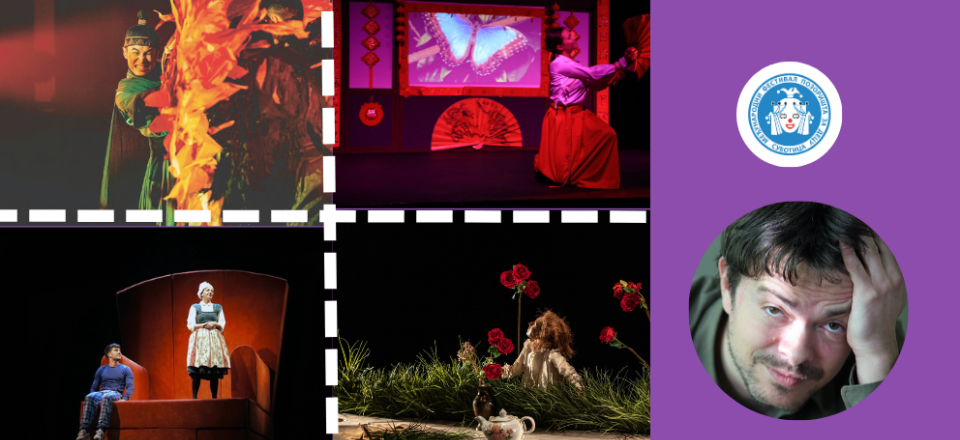
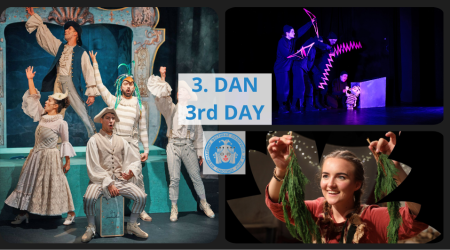
They say that modern China is a highly technologically developed country. Smartphones are nothing special anymore. There are smart household appliances, smart buildings, and even entire smart cities. Without getting into the warnings from technology magnates that artificial intelligence may one day bring about humanity’s downfall, let us simply say that in the production Fantastic Dreams of Mountains and Seas, screens steal a boy’s entire attention until - with a little help from his parents and a book - he discovers the power of imagination.
The Zhejiang Modern Drama Troupe Co., Ltd. arrived at the International Festival of Children’s Theatres - Subotica with a suitcase full of technology, but also of imagination. The third important element of the production is the actors’ physical performance: they are in constant motion, employing a highly intense, physical style of acting in which - according to the Chinese theatrical tradition - expressive facial and eye movements play a dominant role.
There is very little I could say about the text, written by Xiawa Tang. First, because the Chinese production from is non-verbal, and second, because it is based on what the catalogue describes as “the first and most unusual masterpiece” of Chinese literature. Shan Hai Jing, as the mythological text from the ancient periods of China’s dynasties is called, speaks of the origins of the earth and its inhabitants: primarily human beings, but also the origins of the sun, water, sky, and other figures and phenomena familiar to people, regardless of the cultural background of their creation myths.
The production, directed by Miao Zhao, begins as a family story. The parents of a young boy struggle with his unstoppable energy constantly directed towards gadgets and screens, until one day he is drawn into the world of books thus discovering wondrous creatures and the act of creation itself.
The language of the production is extraordinarily fast. Events follow one another at a furious pace. One moment the boy is in his family environment; the next, strange fairy-tale creatures are developing all around him. They reminded me of dragons and birds, and shortly afterwards he encounters a mysterious hero with a bow and arrows capable of influencing the forces developing around the two of them. All the while, other celestial bodies are present around them, represented as bright, colourful spheres. Human beings are mostly depicted as small clay sculptures, pointing to their origins, fragility, and vulnerability in situations when they need the help of the boy and the hero. I found it difficult to keep track of all the plot threads and simply relax or rather - to surrender myself to the performance.
The production’s defining stylistic feature is its extensive use of music - that is, sound - and its synchronisation with stage movement, or action. The sound design is accompanied by highly striking lighting design, creating on stage a unique mixture of theatre and video game. Unlike a video game, where the heroes are digital as well, here we have performers, actors, who give the entire story a human form and charm. It is therefore undeniably easy to find an instructive meaning in the production, although it is equally easy to see it as competing with the things that attract younger generations today - which is not tradition or culture in the fundamental sense, as something belonging to the past.
***
I wondered what the guests from China thought of Amela Vucenović’s Butterflies in Love, a production of the Children’s Theatre of Subotica, which was rooted in the tradition of Chinese shadow theatre, employing a highly complex performance technique. The actors work behind a fabric screen, illuminating figures and positioning them so that they can present a detailed story to the audience.
The actors themselves are visible in this production, which also brings their shadows into the function of the story. What is more, at the beginning and end of the performance there is something resembling a folkloric number, while two narrators are also present at the front of the stage.
Returning to the production’s original intention - the shadow theatre itself - it too seemed somewhat “upgraded,” to the point where it almost became a form of vivid animation of the kind used in cartoons - or at least an attempt at one - because there were quite a few technical and stylistic choices that worked against complete theatrical illusion. From certain angles in the audience, one could even observe the light bulbs which disrupted the shadow projections on the screen. And that was not the only awkwardness...
Nevertheless, with sufficient charm and spirit, one can say that they mastered the technique and presented a simple yet beautiful story about a girl who only wanted to receive an education and marry the man she loved, but was prevented from doing so by the rigid constraints of tradition. In one of the most common versions of a love story - the story of thwarted love - the butterflies were there to remind us of lightness, fluttering movement, vividness, but also transience. Perhaps the aspect of their metamorphosis was present in the play as well, although it was not obvious in the production itself.
Also added to the story is a burlesque quality - more familiar to us, than native to Chinese shadow theatre because it is geographically and historically closer to our own culture to which it arrived via development of shadow theatre in Asia, particularly in Turkey . The level of “clashing” and interaction with animals in the production proved attractive and karađoz-like, thus keeping the audience’s attention in full.
One important last remark: my initial thought regarding Chinese Butterflies in Love (which is not a play originally from China) was ‘This feels like cultural appropriation’, however I later realised that this is a matter of world heritage. Any culture can experience its own interpretation within another culture, although powerful cultural and political movements have recently emerged arguing against this, especially when sensitive social subjects are involved.
***
In The Forgotten Story, by the Children’s Theatre of the Republika Srpska, there was one large armchair on stage. Because I had previously seen Andrej Boka’s production Parent: The First Six Years at the Serbian National Theatre, where I noticed oversized objects and even oversized puppets, I understood that Boka was attempting to create something like a unified style and establish a recognisable departure from the usual “miniaturisation” of puppets and other props in children’s theatre.
Set and puppet designer Sandra Nikač created a monumental armchair-like object that served several functions. The actors appeared small upon it, which was particularly important when they played a boy and his grandmother. Its dimensions irresistibly attracted attention, but more importantly, it also represented a house. An armchair is very much associated with comfort and peace, which is precisely what the grandmother’s house is meant to represent.
As the writer of the source material, Mina Petrić offered a convincing plot loop in which a boy listening to his grandmother’s stories himself becomes the protagonist upon his grandmother’s passing. He becomes the hero of a story about a bird and its egg, hidden inside a house, which his grandmother used to tell him while waving her arms as if they were wings.
For a writer, oblivion is often times a good subject matter. How is it that the protagonist does not remember, and, even better, how is it that in the end he remembers what he had forgotten? Mina Petrić makes good use of this in the context of growing up and the possibility of remembering. In doing so, she touches upon - or rather opens up - another important subject that accompanies childhood: loss. Usually this means the loss of grandparents, although I am not entirely certain; it seems to me that Mina Petrić also ventures into bolder territory in her dramatic exploration of loss along family lines. Thus, the boy who has lost his grandmother returns once again to her house (our great armchair) which is now in the possession of oblivion - or nature. Snails, mice, and hedgehogs, vividly created and animated puppets in the production (more precisely, costumes), move freely until the boy discovers what he has been searching for: the answer to the riddle of the bird and its egg in the house.
It remained somewhat unclear where exactly that house was and why the boy had become so close to his grandmother, as did the detail that his parents briefly lost sight of him, allowing him to return to the memory. But this did not bother me particularly. The small animals and the protagonist’s acrobatics helped me forget about stuff that was somewhat irrelevant and surrender to the pleasure of aesthetics and emotion.
***
Several years ago, at the International Festival of Children’s Theatres - Subotica, the main award - and the sympathies of a large part of the audience - went to Luana Gramegna for her production of Cinderella, by Teatro Zaches of Italy. The dark, horror-like story in her interpretation radiated originality and the courage to venture into uncharted waters of children’s theatre.
Luana Gramegna has returned to the Festival in Subotica, only this time she collaborated with the Kragujevac Theatre for Children and Youth, on the production called Alice’s Dreams. Naturally, it is based on the most famous Alice of all – one of Lewis Carroll.
The stage design (Francesco Givone) immediately attracts attention, as there seems to be nothing superfluous on stage. A long table is placed crosswise, with a tablecloth falling all the way to the floor; tiles form a chessboard pattern; the lighting is just dark enough that nothing other than the set can be seen. A stern woman walks back and forth, left and right, and then a little girl in a white nightgown appears, immediately recognisable as Alice. Her restless face, dance movements that seem to come from the heart of contemporary dance, and miniature circus virtuosity with props such as a teapot suggest an even more feverish dream. There are no words, only music.
Dylan Lorimer’s musical score is more than enough to carry an attentive viewer into a world of the unknown. Short tones, unusual harmonies, the sound of almost unrecognisable instruments, and rhythmic structures are the basic characteristics of a composition that accompanies - or is an organic part of - the stage movement. Broken gestures, an unpredictable line in which one hand does not follow the body, while the head itself seems almost unable to remain attached to the shoulders, create a highly exciting stage expression (Alice is played by Staša Blečić).
When Alice chases the rabbit through a hole in the table, the entire table practically opens up and transforms into the world of Wonderland, inhabited by the Caterpillar, the Cheshire Cat, the Queen of Hearts and - perhaps most famously - the Mad Hatter. There are many more characters in the original, but Luana Gramegna’s focus remains, so to speak, on these. The wildly imaginative puppets and their movements - masks that constitute entire faces and even heads - continue to be accompanied by rich physical action.
Among the central questions are some of the most philosophical ones: the question of identity, the question of time (and transience), the changes connected with it, and, my favourite, the question of standards - that is, expectations. Alice clearly does not fit into this structure, and by the end, with a completely uninhibited cry from the actress’s throat, she rejects it altogether, even if it costs her own head.
Once again, the Festival in Subotica invites us to debate how far art for children and young people can - and should - go. In my opinion, productions such as these are a serious and appropriate measure of great artistic ambition, exploration, and skill.
Igor Buric
Back to...-
 23 september 2026
Matej Milošev: Everyone Carries Both Darkness and Light Within
-
 23 september 2026
The Third and Fourth Festival Days - What Do Children Know About Theatre?
-
 23 september 2026
The First Festival Days - Theatrical Explorations, Great and Small
-
 22 september 2026
Fion Wyn Bowen: “It is important to us that children feel they are part of the performance”


Patrons


Organiser and executive producer

CO – organiser

Media sponsors